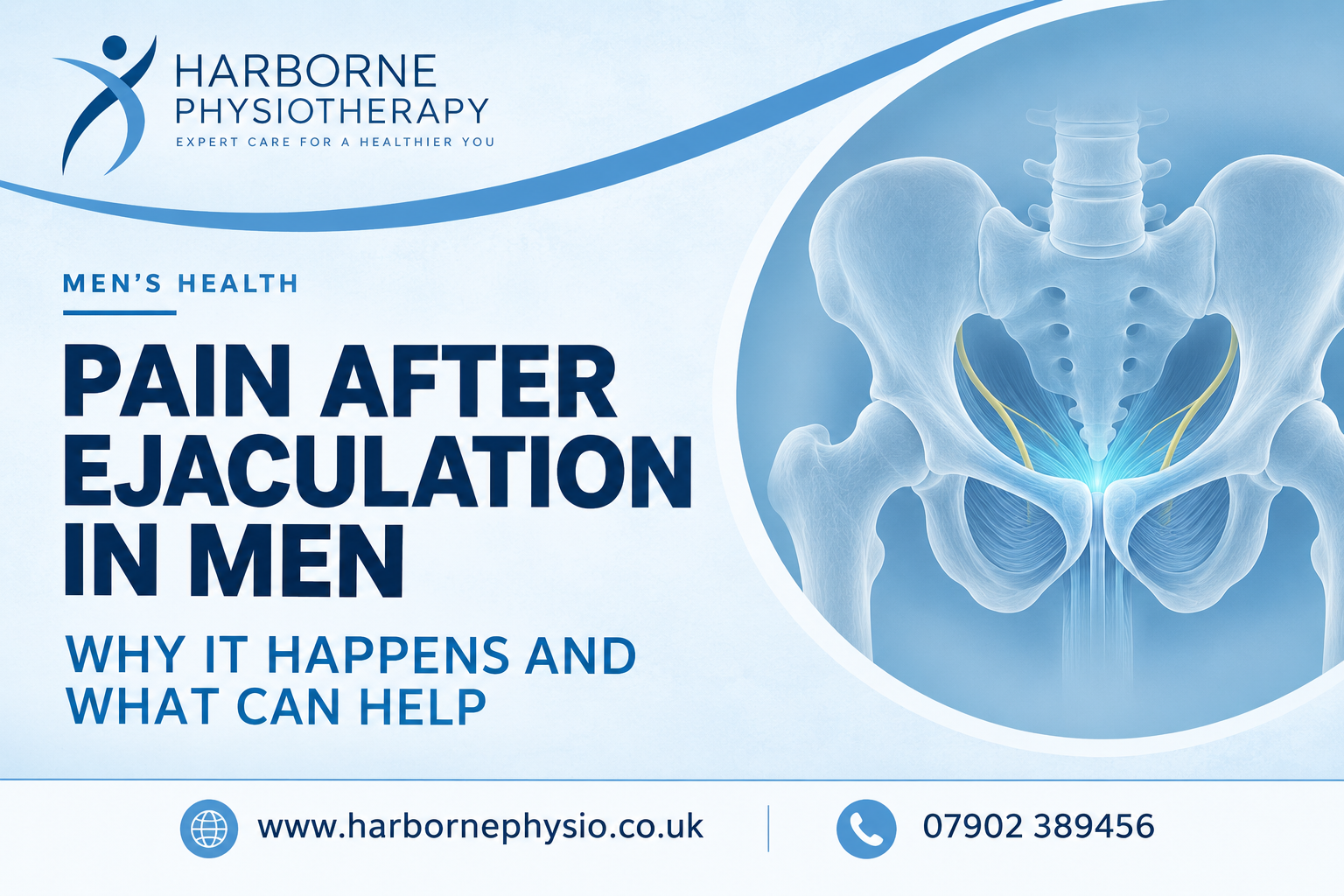
Pain After Ejaculation in Men: Why It Happens and What Can Help
A Birmingham Men’s Health Physiotherapy Guide
Pain during or after ejaculation can be worrying, uncomfortable and extremely frustrating.
Some men experience a sharp pain at the moment of ejaculation. Others describe aching, burning, pressure or tightness that develops afterwards and can last for minutes, hours or occasionally much longer.
The pain may be felt in the penis, testicles, perineum, lower abdomen, rectum or somewhere deep inside the pelvis.
Understandably, many men start to worry about their prostate, infection or whether something has been damaged.
Sometimes there is a medical cause that needs investigating. However, in men with persistent symptoms — particularly when tests have been reassuring — the pelvic floor muscles and wider pelvic pain system can also play an important role.
At Harborne Physiotherapy in Birmingham, our specialist Men’s Health Physiotherapy team regularly sees men experiencing pelvic pain, painful ejaculation, chronic prostatitis-type symptoms, testicular or penile discomfort, urinary symptoms and pelvic floor overactivity.
The important message is that painful ejaculation should not simply be ignored.
There are often things that can be done to help.
What Does Painful Ejaculation Feel Like?
Painful ejaculation can feel very different from one man to another.
Symptoms may include:
• A sharp pain during ejaculation
• Burning immediately afterwards
• Deep pelvic aching
• Pain around the perineum
• Penile or urethral pain
• Testicular discomfort
• Rectal or anal pain
• Lower abdominal discomfort
• A feeling of pelvic pressure or tightness
• Pain that appears several minutes after ejaculation
• A flare-up of existing pelvic pain following sexual activity
For some men the symptoms are relatively mild.
For others, ejaculation becomes such a reliable trigger that they begin avoiding sexual activity completely.
This can understandably affect confidence, relationships and quality of life.
Why Can Ejaculation Cause Pain?
Ejaculation is not simply an event involving the penis.
It involves a coordinated sequence of activity through the nerves, pelvic floor muscles, prostate, seminal structures and surrounding tissues.
The pelvic floor muscles contract rhythmically during ejaculation.
Normally, this happens without pain.
However, if the pelvic floor is already tense, painful, sensitive or unable to relax properly, those repeated contractions can sometimes provoke symptoms.
There are also several other possible causes of painful ejaculation, which is why it is important not to automatically assume that every case is caused by the pelvic floor.
Could It Be Prostatitis?
Possibly.
Prostatitis is one of the first things many men think about when they experience pain following ejaculation.
Acute bacterial prostatitis can occur and requires medical treatment.
However, many men experiencing ongoing pelvic pain have repeatedly negative urine tests and no clear bacterial infection.
They may have been given several courses of antibiotics without significant or lasting improvement.
Some of these men may instead fall into the broader category of Chronic Pelvic Pain Syndrome, sometimes previously labelled chronic non-bacterial prostatitis.
Symptoms can include:
• Perineal pain
• Penile or testicular discomfort
• Pain after ejaculation
• Urinary urgency or frequency
• Discomfort when sitting
• Rectal pressure
• Erectile changes
• Pelvic floor tightness
In these situations, continually treating the problem as an infection may not address what is actually driving the symptoms.
Can a Tight Pelvic Floor Cause Pain After Ejaculation?
Yes, it can contribute.
One of the most common misunderstandings around male pelvic health is that pelvic floor problems always mean the muscles are weak.
They do not.
In men with pelvic pain, the pelvic floor can actually be overactive.
This means the muscles may be holding excessive tension or struggling to fully relax.
Some men unknowingly clench their pelvic floor throughout the day, particularly when they are:
• Stressed
• Exercising
• Sitting for long periods
• Concentrating
• Driving
• Experiencing pain
• Worried about their symptoms
If these muscles are already irritated, repeated contractions during orgasm and ejaculation may trigger further pain or spasm.
This is why simply telling every man with a pelvic problem to do lots of Kegel exercises is not always appropriate.
Sometimes we need to teach the muscles how to relax before we think about strengthening them.
What Other Symptoms Can Occur With an Overactive Pelvic Floor?
Men with pain following ejaculation may also experience:
• A feeling of tightness between the testicles and anus
• Pain when sitting
• Penile pain or altered sensation
• Testicular aching
• Urinary urgency
• Frequent urination
• Difficulty starting urination
• A sensation that the bladder has not completely emptied
• Constipation or difficulty relaxing during a bowel movement
• Erectile difficulties
• Pain or discomfort after exercise
• Symptoms after cycling
• Pelvic pain following gym training
When several of these symptoms occur together, assessing the pelvic floor can be particularly useful.
What About the Pudendal Nerve?
The pudendal nerve is one of the major nerves supplying the pelvic region.
It provides sensation and function to areas including the penis, scrotum, perineum and anus.
If the pudendal nerve or surrounding tissues become irritated or sensitive, symptoms can include:
• Burning
• Tingling
• Numbness
• Penile or perineal pain
• Pain when sitting
• Sexual pain
• Pain following ejaculation
This does not mean that every man with these symptoms has pudendal neuralgia or permanent nerve damage.
Pelvic floor tension, prolonged sitting, cycling, back or hip problems and increased sensitivity within the nervous system may all influence the way the pudendal nerve behaves.
This is why a specialist assessment looks at much more than one structure.
Why Does Stress Sometimes Make It Worse?
Pelvic pain is physical.
But that does not mean stress has no influence on it.
Think about what happens to your body when you are under pressure.
Your jaw may tighten.
Your shoulders lift.
Your breathing changes.
And your pelvic floor can tighten too.
For somebody already experiencing pelvic pain, prolonged stress can increase muscle guarding and make an already sensitive nervous system more reactive.
Sexual activity itself can then become stressful because the man starts thinking:
“Is it going to hurt again?”
“How bad will it be afterwards?”
“Have I damaged something?”
That anticipation can increase tension before sexual activity has even started.
Treatment therefore needs to address both the physical drivers and the way the nervous system is responding to the pain.
This does not mean the symptoms are imaginary or “all psychological”.
Should I Stop Ejaculating?
Not necessarily.
Many men respond to painful ejaculation by stopping all sexual activity.
Temporarily reducing a clear trigger during a significant flare may sometimes be sensible.
However, long-term avoidance can also increase fear around sexual activity.
A better approach is usually to understand what is triggering the symptoms and gradually rebuild tolerance.
For some men this might involve spacing sexual activity while symptoms settle.
For others it may involve pelvic floor relaxation before and after sex, modifying other aggravating activities, or treating associated pelvic pain first.
There is no single rule that applies to everyone.
Should I Do Pelvic Floor Exercises?
This depends on what your pelvic floor is doing.
If your pelvic floor is weak, strengthening may be appropriate.
If it is already overactive and painful, repeatedly squeezing harder may aggravate symptoms.
We frequently meet men who have searched online, found pelvic floor exercises and started performing hundreds of contractions.
Unfortunately, their symptoms sometimes worsen.
Before deciding whether you need to strengthen your pelvic floor, it is useful to establish whether you can:
• Contract it correctly
• Relax it fully
• Coordinate it with breathing
• Use it without excessive abdominal or gluteal tension
• Allow it to lengthen appropriately
The correct programme depends on the individual.
How Can Men’s Health Physiotherapy Help?
The first step is understanding the full story.
A specialist Men’s Health Physiotherapy assessment may consider:
• Where your pain is located
• When the symptoms began
• What happens during and after ejaculation
• Pelvic floor function
• Sitting tolerance
• Hip and lower back movement
• Abdominal muscle tension
• Breathing patterns
• Bladder symptoms
• Bowel function
• Exercise and gym training
• Cycling
• Sexual symptoms
• Stress and flare-up patterns
We are trying to identify what is contributing to your symptoms rather than simply treating the painful area.
What Might Treatment Involve?
Treatment depends on what we find.
It may include:
• Education about what may be driving your symptoms
• Pelvic floor relaxation and down-training
• Breathing exercises
• Manual therapy where appropriate
• Hip and lower back rehabilitation
• Advice about sitting and work
• Bladder or bowel strategies
• Modification of gym or cycling loads
• Gradual return to normal sexual activity
• Strategies to manage flare-ups
• A personalised home programme
For some men we may also use real-time ultrasound imaging to help assess pelvic floor movement and teach better muscle control.
Treatment should always be individualised.
Is an Internal Pelvic Floor Examination Always Necessary?
No.
An internal examination is not automatically required.
A lot can be learned from the history, movement assessment, breathing, external examination and ultrasound imaging where appropriate.
In some circumstances an internal pelvic floor examination may provide useful additional information about muscle tension, tenderness and coordination.
If this is considered appropriate, it should always be explained beforehand and only performed with your full consent.
What About Exercise and the Gym?
Exercise is not automatically bad for pelvic pain.
However, some men notice that symptoms are aggravated by heavy gym training, particularly exercises involving high abdominal pressure or excessive bracing.
These might include:
• Heavy squats
• Deadlifts
• Leg press
• Intense abdominal training
• High-volume cycling
• Very heavy compound lifting
This does not mean these exercises must be avoided forever.
Sometimes we temporarily modify training while symptoms settle and then gradually rebuild it.
The goal is usually to get you back to exercise, not to make you frightened of it.
When Should Pain After Ejaculation Be Medically Investigated?
New or unexplained painful ejaculation deserves appropriate medical assessment, particularly if symptoms are persistent.
Speak to your GP, urologist or another appropriate medical professional if you have concerns.
Medical assessment is particularly important if you also experience symptoms such as:
• Blood in the urine
• Blood in semen
• Fever or feeling unwell
• New severe testicular pain
• A testicular lump or swelling
• Difficulty passing urine
• Unexplained weight loss
• New neurological symptoms
• Symptoms following surgery or a new medication
Physiotherapy should complement appropriate medical assessment rather than replace it.
What If All My Tests Are Normal but I Still Have Pain?
We see this situation frequently.
Being told that scans, urine tests or other investigations are normal is reassuring from a medical perspective.
But it can be frustrating when you are still in pain.
Normal investigations do not mean that nothing is wrong.
Muscles can be overactive.
Nerves can become sensitive.
Movement patterns can change.
The nervous system can become more protective.
None of these things necessarily appears on a standard scan.
This is where specialist pelvic health physiotherapy can be particularly useful.
Can Pain After Ejaculation Get Better?
Yes, many men improve.
Recovery depends on the cause, how long symptoms have been present and what other factors are involved.
Progress may involve:
• Less pain after ejaculation
• Symptoms settling more quickly
• Improved sitting tolerance
• Reduced pelvic tension
• Fewer urinary symptoms
• Increased confidence with sexual activity
• Returning to gym, cycling or sport
• Less worry about flare-ups
Progress is not always perfectly linear.
You may have good weeks and occasional flare-ups.
The important thing is having a better understanding of the problem and knowing what to do when symptoms increase.
How We Can Help at Harborne Physiotherapy
At Harborne Physiotherapy in Birmingham, our specialist Men’s Health Physiotherapists regularly assess and treat men experiencing:
• Pain during or after ejaculation
• Male pelvic pain
• Chronic Pelvic Pain Syndrome
• Prostatitis-type symptoms
• Pudendal nerve pain
• Penile and testicular pain
• Pain with sitting
• Urinary urgency and frequency
• Pelvic floor overactivity
• Erectile difficulties
• Hard Flaccid Syndrome
These can be difficult symptoms to talk about, but for us they are part of everyday clinical practice.
Our aim is to listen, explain what may be happening and build a practical rehabilitation plan that helps you move forward.
You do not have to simply tolerate painful ejaculation or stop sexual activity because you are frightened of provoking symptoms.
With the right medical assessment and specialist physiotherapy where appropriate, there may be a lot that can be done.
Book an Appointment
If you are experiencing pain during or after ejaculation, pelvic pain, penile or testicular discomfort or prostatitis-type symptoms, contact our specialist team for an assessment.
Harborne Physiotherapy Clinic
@ Barefoot Yoga Harborne
7 High Street
Harborne
Birmingham B17 9NT
Telephone: 07902 389456
Appointments can also be booked through the Harborne Physiotherapy website.
www.harbornephysio.co.uk